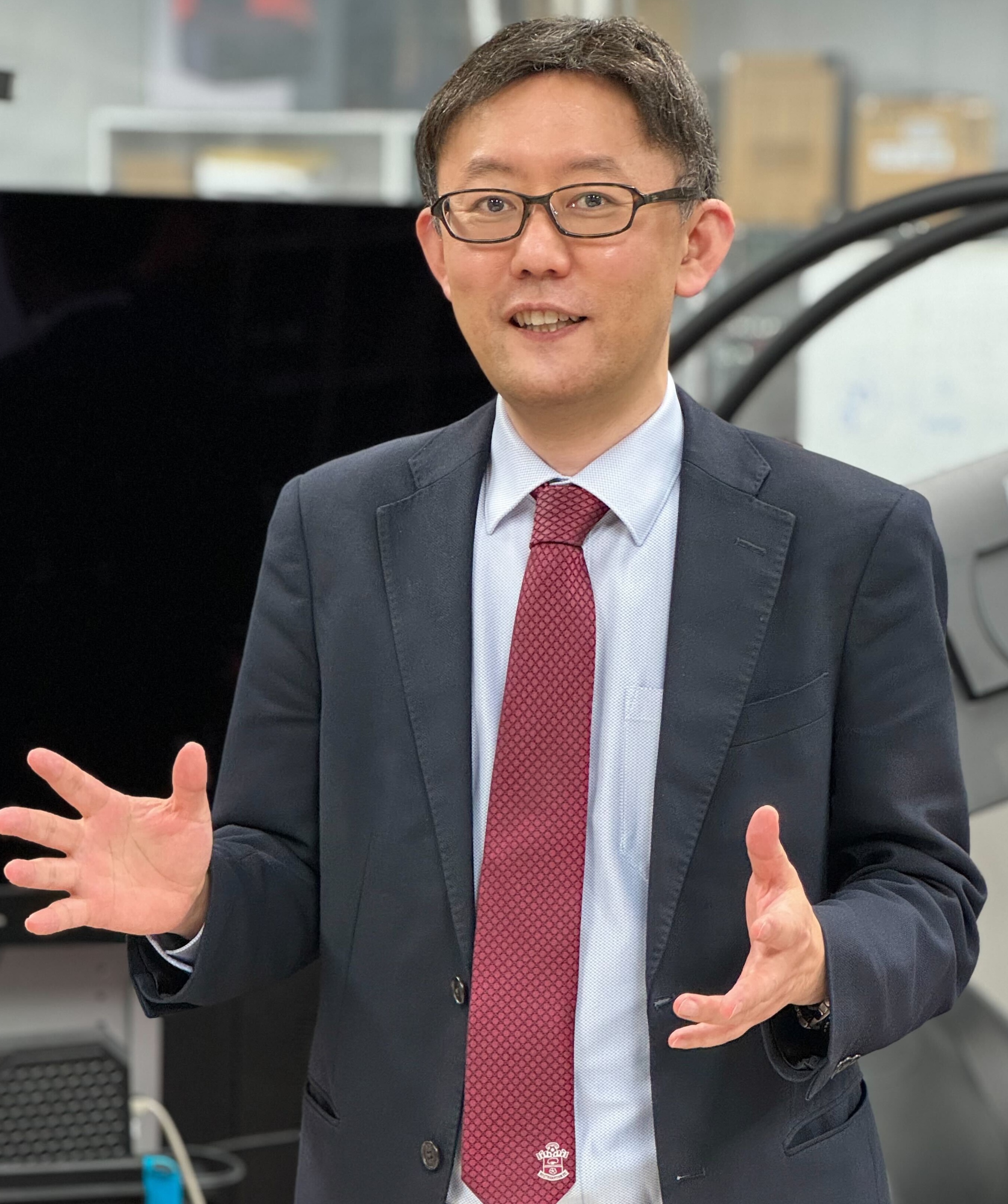
DAISUKE KATAGAMI / Ph.D.
Daisuke Katagami
Information Technology Course, Department of Engineering, Faculty of Engineering, Tokyo Polytechnic University
Professor / Director of Academic Affairs, Faculty of Engineering
Ph.D. in Engineering
Through interactions between people, agents, and robots, I study intelligent systems that can live alongside people of diverse personalities.

Biography
- 1992 — Graduated from Saitama Prefectural Kasukabe High School
- 1996 — Graduated from the Department of Mechanical and Control Engineering, Faculty of Electro-Communications, the University of Electro-Communications
- 1999 — Completed the master's program in Computational Intelligence and Systems Science, Interdisciplinary Graduate School of Science and Engineering, Tokyo Institute of Technology
- 2002 — Completed the doctoral program in Computational Intelligence and Systems Science, Interdisciplinary Graduate School of Science and Engineering, Tokyo Institute of Technology Ph.D. in Engineering
- 2002 — Research Associate, Department of Computational Intelligence and Systems Science, Interdisciplinary Graduate School of Science and Engineering, Tokyo Institute of Technology
- 2004–2007 — Part-time Lecturer, Faculty of Environmental and Information Studies, Musashi Institute of Technology (concurrent appointment)
- 2006 — Visiting Researcher, University of Hertfordshire, UK (concurrent appointment)
- 2006–2007 — Visiting Researcher, University of Zurich, Switzerland (concurrent appointment)
- 2007 — Assistant Professor, Department of Computational Intelligence and Systems Science, Interdisciplinary Graduate School of Science and Engineering, Tokyo Institute of Technology
- 2010– — Associate Professor, Department of Applied Computer Science, Faculty of Engineering, Tokyo Polytechnic University
- 2011–2012 — Part-time Lecturer, Nippon Sport Science University (concurrent appointment)
- 2017– — Professor, Department of Applied Computer Science, Faculty of Engineering, Tokyo Polytechnic University
- 2018– — Professor, Department of Applied Computer Science / Director of Student Affairs, Faculty of Engineering, Tokyo Polytechnic University
- 2020– — Professor, Information Technology Course, Department of Engineering / Director of Student Affairs, Faculty of Engineering, Tokyo Polytechnic University
- 2024– — Professor, Information Technology Course, Department of Engineering / Director of Academic Affairs, Faculty of Engineering, Tokyo Polytechnic University
Professional memberships
- Japanese Society for Artificial Intelligence (JSAI)
- Japan Society for Fuzzy Theory and Intelligent Informatics (SOFT)
- Human Interface Society
- IEEE
- ACM
Academic service
- JSAI — Delegate (2021–)
- JSAI — Director (2019–2022)
- JSAI Annual Conference — Program Chair (2019–2020)
- JSAI Annual Conference — Program Vice Chair (2019)
- JSAI — Councilor (2007–2010)
- JSAI — Editorial Board Member (2010–2014)
- JSAI — Planning Committee Member (2009–2011)
- JSAI SIG on Data-Oriented Constructive Mining and Simulation (SIG-DOCMAS) — Steering Committee Member (2010–2026)
- SOFT — Director (2015–2017)
- SOFT — Councilor (2018–)
- SOFT — Editorial Board Member (2007–2015); Acting Chair of the Paper Committee (2012)
- SOFT Human Symbiotic Systems Research Group — Deputy Representative Secretary (2007–2019); Advisor (2020–)
- IEICE Technical Committee on Artificial Intelligence and Knowledge-Based Processing (SIG-AI) — Committee Member (2020–)
- IEICE Technical Committee on Artificial Intelligence and Knowledge-Based Processing (SIG-AI) — Vice Chair (2015–2019)
- IEICE Technical Committee on Artificial Intelligence and Knowledge-Based Processing (SIG-AI) — Secretary (2011–)
- IPSJ SIG on Intelligence and Complex Systems — Steering Committee Member (2006–2010)
- IPSJ SIG on Game Informatics — Steering Committee Member (2017–2019)
- Journal of Advanced Computational Intelligence and Intelligent Informatics — Editorial Board Member (2009–)
- International Conference on Human-Agent Interaction — Publicity Chair (2013–2015)
- International Symposium on Robot and Human Interactive Communication — Associate Editor (2015)
- International Workshop on Advanced Computational Intelligence and Intelligent Informatics — International Program Committee (2010–2011)
- International Symposium on Advanced Intelligent Systems (ISIS) — International Program Committee (2006–2010)
- European Workshop on Interactive Evolution and Humanized Computational Intelligence — International Program Committee (2006–2009)
- Joint Agent Workshops and Symposium (JAWS) — Senior Program Committee (2014–2015)
- Joint Agent Workshops and Symposium (JAWS) — Program Committee (2005–2013, 2016–2017)
- HAI Symposium — Program Committee (2006–); Steering Committee (2009–); Organizing Co-chair (2015–); Steering Chair (2017–2019); Advisor (2019–)
- Fuzzy System Symposium (FSS) — Program Chair (2015, 2016)
- JSAI Annual Conference — Program Committee and Organizing Committee (2005–2006)
Research funding
- FY2022–2023 — KAKENHI Scientific Research on Innovative Areas (Research in a Proposed Research Area),Principal Investigator
“Developing an affinity-building dialogue system using speech-level shifts based on DP theory” - FY2020–2021 — KAKENHI Scientific Research on Innovative Areas (Research in a Proposed Research Area),Principal Investigator
“Developing an affinity-building dialogue system based on politeness theory and natural conversation corpora” - FY2020–2022 — KAKENHI Scientific Research (C), Co-Investigator
“Engineering support for learning how to interact with people with dementia in family settings” - FY2019–2022 — KAKENHI Scientific Research (B), Co-Investigator
“Analyzing Werewolf players' thinking through controlled experiments based on game scenarios” - FY2018–2021 — KAKENHI Scientific Research (B), Co-Investigator
“Understanding physical interactions that create empathy in group discussions and supporting their acquisition” - FY2018–2021 — KAKENHI Scientific Research (A), Co-Investigator
“Constructing a natural conversation corpus of 1,000 Japanese speakers for pragmatic analysis and multifaceted research” - FY2017–2020 — KAKENHI Scientific Research (C), Co-Investigator
“Engineering support for improving social skills in multi-person social situations” - FY2016–2019 — KAKENHI Scientific Research (B), Co-Investigator
“Analyzing the thinking processes of Werewolf players” - FY2016 — Tokyo Polytechnic University Supporters' Association Education and Research Grant,Principal Investigator
“A collaborative inter-university design contest exploring human–system symbiosis” - FY2015 — Tokyo Polytechnic University Faculty of Engineering Special Research and Education Grant
“Developing intelligent agents for education in persuasive dialogue using Werewolf”,Principal Investigator - FY2015–2017 — KAKENHI Scientific Research (B), Co-Investigator
“A tactile communication robot modeled on a hearing assistance dog” - FY2015–2017 — KAKENHI Challenging Exploratory Research, Co-Investigator
“Werewolf research: toward persuasive AI that considers how others model the self” - FY2014 — Tokyo Polytechnic University Supporters' Association Education and Research Grant,Principal Investigator
“A collaborative inter-university design contest exploring human–system symbiosis” - FY2013 — Tokyo Polytechnic University Faculty of Engineering Special Research and Education Grant
“Developing discommunication robots that elicit active human communication by not communicating”,Principal Investigator - FY2013 — Tokyo Polytechnic University Supporters' Association Education and Research Grant,Principal Investigator
“A collaborative inter-university design contest exploring human–system symbiosis” - FY2013–2015 — KAKENHI Scientific Research (C), General,Principal Investigator
“Artificial atmosphere generation and interaction design through cross-cultural simulations” - FY2013 — Foundation for the Fusion of Science and Technology Research Grant,Principal Investigator
“Building an educational system based on an online cross-cultural simulation game” - FY2012 — Institute of Statistical Mathematics Cooperative Research Program,Principal Investigator
“Exploring support for stranded commuters using social networks” - FY2012 — Tokyo Polytechnic University Faculty of Engineering Special Research and Education Grant,Principal Investigator
“Developing interactive digital signage using embodied agents” - FY2012 — Tokyo Polytechnic University Supporters' Association Education and Research Grant,Principal Investigator
“A collaborative inter-university design contest exploring human–system symbiosis” - FY2011–2012 — Nakayama Hayao Foundation for Science & Technology and Culture Grant,Principal Investigator
“Online cross-cultural simulations using a multi-touch user interface” - FY2009–2010 — KAKENHI Young Scientists (B), Project 21700153,Principal Investigator
“Understanding hidden specialties through research-field networks” - FY2008–2010 — KAKENHI Scientific Research (B), General, Project 20300054, Co-Investigator
“Supporting argumentation and mediation based on the logical structure of laws” - FY2007–2008 — KAKENHI Young Scientists (B), Project 19700132,Principal Investigator
“Analyzing networks between research fields using bibliographic information” - FY2007–2008 — KAKENHI Scientific Research (C), Time-Limited, Project 19601002, Co-Investigator
“Building Nexus, a knowledge-capital network infrastructure for academic productivity and educational effectiveness” - FY2006 — MEXT Program for Internationalization of University Education (Support for Advanced Overseas Research),Principal Investigator
“Designing social agents” - FY2006 — Tokyo Institute of Technology 21st Century COE Young Researcher Grant,Principal Investigator
“Multitask reinforcement learning based on social intelligence” - FY2005–2006 — KAKENHI Young Scientists (B), Project 17700177,Principal Investigator
“Designing social agents using human–agent interaction” - FY2005–2006 — KAKENHI Scientific Research (C), General, Project 17500087, Co-Investigator
“Developing a case-based education support system for alternative dispute resolution” - FY2005 — Tokyo Institute of Technology 21st Century COE Young Researcher Grant,Principal Investigator
“Social intelligence based on social reinforcement learning” - FY2004 — Tokyo Institute of Technology 21st Century COE Young Researcher Grant,Principal Investigator
“Realizing sociality in human–agent interaction” - FY2003–2004 — Kayamori Foundation of Informational Science Advancement,Principal Investigator
“Online learning in interactive evolutionary robotics” - FY2002 — Hara Research Foundation Grant, First Half / 22nd Round,Principal Investigator
Invited talks and other presentations
- Daisuke Katagami: “Praise and comfort: supportive partners and evolving communication robots”, exclusive interview with Click and Pay LLC (2024.11)
- Daisuke Katagami: “Relationships between people and systems through dialogue systems based on linguistic consideration”, Cognitive Communication Workshop, invited talk (2024.8)
- Daisuke Katagami: “Building new relationships between people and systems through dialogue systems based on linguistic consideration”, 56th Tokai Fuzzy Workshop, invited talk (2024.8)
- Daisuke Katagami: “Introducing a listening training system for family caregivers of people with dementia”, Care-sul Kaigo (2024.3)
- Daisuke Katagami: “Designing politeness theory in AI”, 3rd Conversation and Discourse Research Symposium, “AI and Language Research (1): Politeness and AI” (2018.6)
- Daisuke Katagami: “Systems that live with people: creating atmosphere through language and gestures”, NINJAL Colloquium, National Institute for Japanese Language and Linguistics (2018.3)
- Daisuke Katagami: Panel discussion on future micro-logistics with communication, “Designing Well-being in Everyday Life” Symposium, DENSO (2017.6)
- Daisuke Katagami: “Computers in social groups: creating systems that live with people”, Tokyo Polytechnic University public lecture (2016.11)
- Daisuke Katagami: “Virtual agents”, JSAI × CEDEC collaboration session on AIWolf technology, CEDEC2016 (2016.8)
- Daisuke Katagami: “Letting Hatsune Miku play Werewolf: the AIWolf project”, Cognitive Communication Workshop (2015.9)
- Daisuke Katagami: “AIWolf research today: studies of face-to-face interfaces”, AIWolf Competition, CEDEC2015 (2015.8)
- Daisuke Katagami: “Letting Hatsune Miku play Werewolf”, 6th Nico Nico Gakkai Beta Data Workshop (2015.4)
- Daisuke Katagami: “Introduction to human symbiotic systems research: creating systems that live with people”, Cognitive Communication Workshop (2014.9)
- Daisuke Katagami: “Mood engineering: understanding and creating atmosphere”, IEICE joint HCS & VNV workshop (2014.8)
- Daisuke Katagami: “People puzzled by agents: humans and artifacts in social groups”, Cognitive Communication Workshop (2012.9)
- 片上大輔: 人間とPCの中の人間との共生コミュニケーション, 夢ナビライブ, 東京ビッグサイト (2012.7)
- Daisuke Katagami: “Puzzled by groups: humans and artifacts in social groups”, Cognitive Communication Workshop (2011.9)
Special issues and editorial service
- SOFT special issue “Human Symbiotic Systems and Their Applications” — Organizer and Editorial Committee (2018.10)
- SOFT special issue “Human Interactive Systems” — Guest Editor (2015.12)
- JSAI special issue “Application-Oriented Neuroscience Experiments” — Editorial Committee (2015.05)
- IEICE Transactions (Japanese Edition A), special issue “Interaction between Humans and Agents” — Editorial Committee (2014.6)
- JSAI special issue “Human–Agent Interaction (HAI)” — Organizer and Editorial Secretary; 20 submissions, 13 published (2013.03)
- Human Interface Society special issue “Minimal Design of Interaction” — Editorial Committee (2013.02)
- SOFT special issue “Intelligent Systems Interacting with People” — Organizer and Guest Editor; 23 submissions, 13 published (2012.10)
- IEICE Transactions (Japanese Edition A), special issue “Interaction between Humans and Agents” — Editorial Committee; 44 submissions, 17 published (2012.1)
- Journal of Advanced Computational Intelligence and Intelligent Informatics (JACIII), Vol. 14, No. 7, “Human Symbiotic System” — Guest Editor; 22 submissions, 14 published (2010.11)
- SOFT special issue “Human Symbiotic Systems” — Organizer and Editorial Committee; 27 submissions, 18 published (2009.10)
- IPSJ special issue “Theory and Applications of Multi-Agent Systems” — Editorial Committee; 45 submissions, 15 published (2006.5)
Organized sessions and workshops
- JSAI Annual Conference 2024 KS-8 AIWolf Contest 2024, Domestic Competition, Natural Language Division(2024.5)
- 1st Workshop on AI Werewolf and Dialog System, Organisers: Yoshinobu Kano, Michimasa Inaba, Fujio Toriumi, Hirotaka Osawa, Daisuke Katagami, Takashi Otsuki (AIWolfDial2019) (2019.10)
- JSAI Annual Conference 2019 “AIWolf and Games with Incomplete Information” (2 sessions, 9 papers) (2019.6)
- HCG Symposium 2018, organized session “Mood Engineering” (2 sessions, 11 papers) (2018.12)
- JSAI Annual Conference 2018 “AIWolf and Games with Incomplete Information” (2 sessions, 8 papers, 1 competition) (2018.6)
- HCG Symposium 2017, organized session “Mood Engineering” (2 sessions, 11 papers) (2017.12)
- JSAI Annual Conference 2017 “What is at the heart of HAI? Exploring AI-based interaction technologies” (2 sessions) (2017.5)
- HCG Symposium 2016, organized session “Mood Engineering” (2 sessions, 8 papers) (2016.12)
- CEDEC2016 JSAI × CEDEC collaboration session on AIWolf technology (2016.08)
- JSAI Annual Conference 2016, “HAI Connecting People and Artificial Intelligence” (2 sessions, 9 papers) (2016.6)
- HCG Symposium 2015, “Mood Engineering” (2 sessions, 9 papers) (2015.12)
- CEDEC2015 AIWolf Competition (2015.08)
- JSAI Annual Conference 2015, “Creating Sociability and Atmosphere through HAI” (2 sessions, 10 papers) (2015.5)
- HCG Symposium 2014, “Mood Engineering” (4 sessions, 16 papers) (2014.12)
- 2nd International Conference on Human-Agent Interaction (HAI2014)
The 1st International Workshop on Mood Engineering "Creating Effective Moods with Robots/Agents" (2014.10) ACM Digital Library - JSAI Annual Conference 2014, “Mood Engineering” (2 sessions, 9 papers) (2014.5)
- 29th Fuzzy System Symposium (FSS2013), “Human Symbiotic Systems” (5 sessions, 24 papers) (2013.9)
- JSAI Annual Conference 2013, “Mood Engineering: Toward Further Development of Human Communication Research” (3 sessions, 15 papers) (2013.6)
- The 6th International Conference on Soft Computing and Intelligent Systems The 13th International Symposium on Advanced Intelligent Systems (SCIS&ISIS2012) “Human Symbiotic System” (2 sessions, 7 papers) (2012.11)
- 28th Fuzzy System Symposium (FSS2012), “Human Symbiotic Systems” (8 sessions, 29 papers, 5 evening poster papers) (2012.9)
- IEEE World Congress on Computational Intelligence (WCCI2012), (FUZZ-IEEE & CEC & IJCNN) “Human Symbiotic System” (1 session, 8 papers) (2012.6)
- IEICE General Conference 2012, organized symposium “Sociality and Agents” (1 session, 3 papers) (2012.3)
- 27th Fuzzy System Symposium (FSS2011), “Human Symbiotic Systems” (8 sessions, 32 papers, 14 interactive poster papers) (2011.9)
- The 2011 IEEE International Conference on Fuzzy Systems “Human Symbiotic System” (1 session, 7 papers) (2011.6)
- 20th Intelligent Symposium FAN2010, “Human Symbiotic Systems” (3 sessions, 10 papers) (2010.9)
- 26th Fuzzy System Symposium (FSS2010), “Human Symbiotic Systems” (5 sessions, 22 papers) (2010.9)
- The 2010 IEEE International Conference on Fuzzy Systems, IEEE WCCI2010 "Human Symbiotic System" (2 sessions, 8 papers) (2010.7)
- The 19th Intelligent Symposium FAN2009 "Human Symbiotic System I & II" (3 sessions, 10 papers) (2009.9)
- The 2009 IEEE International Conference on Fuzzy Systems “Human Symbiotic System”(2 sessions, 8 papers) (2009.8)
- 25th Fuzzy System Symposium (FSS2009), “Human Symbiotic Systems” (3 sessions, 11 papers) (2009.7)
- Joint 3rd International Conference on Soft Computing and Intelligent Systems and 7th International Symposium on Advanced Intelligent Systems (SCIS&ISIS2008) “Human Symbiotic System”(2 sessions, 7 papers) (2008.9)
- 24th Fuzzy System Symposium (FSS2008), “Human Symbiotic Systems” (3 sessions, 15 papers) (2008.9)
- The 2008 IEEE International Conference on Fuzzy Systems, IEEE WCCI2008 “Human Symbiotic System”(1 session, 6 papers) (2008.6)
- The Second International Conference on Innovative Computing, Information and Control (ICICIC2007) (1 session, 6 papers) (2007.9)
- Joint 3rd International Conference on Soft Computing and Intelligent Systems and 7th International Symposium on Advanced Intelligent Systems (SCIS&ISIS2006) “Human-Agent Interaction”(2 sessions, 9 papers) (2006.9)
- The 3rd International Symposium on Autonomous Minirobots for Research and Edutainment (AMiRE2005) “Human-Agent Interaction and Social Robots”(1 session, 4 papers) (2005.9)
Teaching
- 2014– — Advanced Intelligent Information Processing, Graduate Program in Electronics and Information Technology, Tokyo Polytechnic University
- FY2013–FY2017 — Basic Engineering Experiments (autumn), Department of Applied Computer Science, Faculty of Engineering, Tokyo Polytechnic University
- 2012– — Human Motion Information Analysis (autumn), Department of Applied Computer Science, Faculty of Engineering, Tokyo Polytechnic University
- 2011– — Technical Writing and Presentation (autumn), Department of Applied Computer Science, Faculty of Engineering, Tokyo Polytechnic University
- 2011– — Soft Computing (spring), Department of Applied Computer Science, Faculty of Engineering, Tokyo Polytechnic University
- 2011– — Research and Production Workshop (spring), Department of Applied Computer Science, Faculty of Engineering, Tokyo Polytechnic University
- 2011– — Advanced Computational Intelligence (spring), Graduate Program in Electronics and Information Technology, Tokyo Polytechnic University
- 2011 — Information Processing (spring), Nippon Sport Science University
- 2010– — Introductory Seminar in Applied Computer Science (spring), Department of Applied Computer Science, Faculty of Engineering, Tokyo Polytechnic University
- 2010– — Computer Fundamentals (spring), Department of Applied Computer Science, Faculty of Engineering, Tokyo Polytechnic University
- 2010–2011 — Introduction to Information Technology (spring), Department of Applied Computer Science, Faculty of Engineering, Tokyo Polytechnic University
- 2010–2011 — Natural Language Processing (spring), Graduate Program in Electronics and Information Technology, Tokyo Polytechnic University
- 2010–2012 — Information Retrieval and Research Basics (autumn), Department of Applied Computer Science, Faculty of Engineering, Tokyo Polytechnic University
- 2010–2011 — Basic Programming (autumn), Department of Applied Computer Science, Faculty of Engineering, Tokyo Polytechnic University
- 2004–2008 — Information Literacy Exercises, Part-time Lecturer, Faculty of Environmental and Information Studies, Musashi Institute of Technology
- 2002–2005 — Systems Modeling (teaching support), Department of Computational Intelligence and Systems Science, Tokyo Institute of Technology
- 2002–2005 — Adaptive Systems (exercises), Department of Computational Intelligence and Systems Science, Tokyo Institute of Technology
- 2002–2005 — Information Network Systems (teaching support), Department of Computational Intelligence and Systems Science, Tokyo Institute of Technology